

Understanding the Role of a Product-Led Sales Leader
Hiring a product-led sales leader is not simply about finding someone who can close deals; it’s about identifying a professional who can align the sales strategy with the product’s core strengths and adoption patterns. Unlike traditional sales leaders who focus primarily on quota attainment and outbound strategies, a product-led sales leader leverages product usage data to drive growth. They are deeply invested in understanding how customers interact with the product and identifying opportunities to convert engagement into revenue. This type of leader works closely with product, marketing, and customer success teams to create a seamless experience that encourages expansion and retention. Their approach requires analytical thinking, a collaborative mindset, and the ability to translate insights into actionable sales tactics. A product-led sales leader must also be comfortable experimenting with strategies, measuring results, and iterating quickly. In fast-moving SaaS environments, they act as both strategist and practitioner, bridging the gap between product capabilities and revenue generation.
Recognizing the Need at Different Company Stages
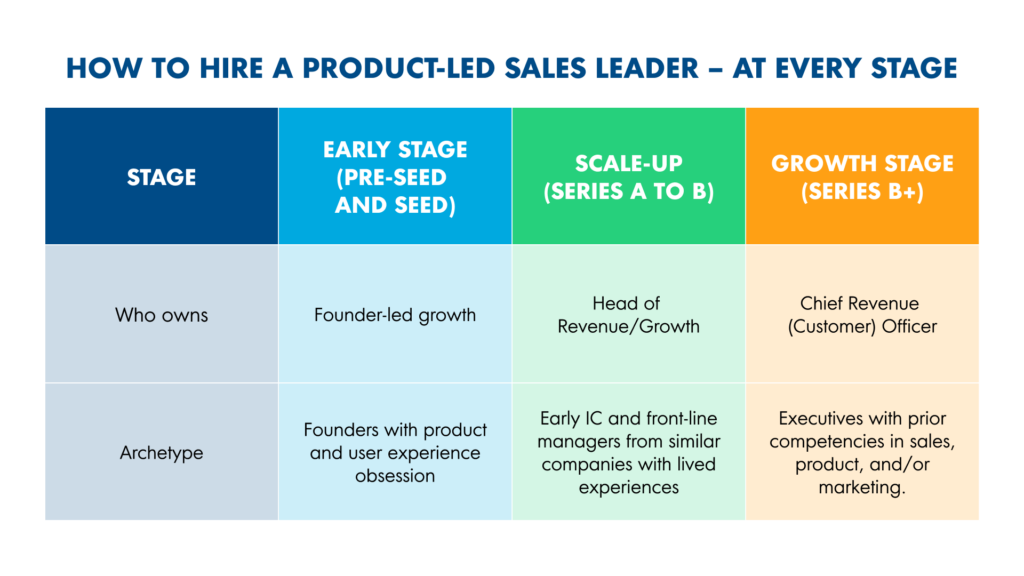
Different stages of a company’s lifecycle require different approaches to product-led sales leadership. In early-stage startups, the priority is finding someone who can wear multiple hats, execute directly with minimal resources, and help define the revenue engine. Growth-stage companies need leaders who can scale teams, refine processes, and establish metrics that track both product adoption and revenue. Enterprise-stage organizations demand leaders who can influence multiple departments, design cross-functional strategies, and manage large-scale initiatives. Identifying organizational gaps is crucial: you must ask whether your current team is hitting revenue targets, effectively communicating product value, and driving adoption. Understanding these gaps allows you to define the type of leader who can fill them. Misalignment at this stage can lead to wasted investment and slow growth. Recognizing the stage-specific needs ensures that the hire will have the right impact and authority.
Key Traits and Skills to Look For
A product-led sales leader must combine analytical insight with strong interpersonal skills. They need the ability to interpret product usage data to uncover customer behavior patterns. Collaboration with product, marketing, and customer success teams is essential to ensure the sales strategy supports the overall business objectives. Leadership skills are vital: they must inspire and develop teams while fostering a culture of experimentation and learning. Adaptability is another key trait, as product features and market conditions often change rapidly. A strategic mindset, combined with a hands-on approach, ensures that both short-term wins and long-term growth are achievable. Finally, resilience and a willingness to challenge assumptions help leaders continuously improve processes and outcomes.
Hiring Strategies for Each Stage
Hiring approaches should adapt to the company’s growth stage.
-
Early-stage startups: prioritize candidates who are versatile, willing to get hands-on, and comfortable with ambiguity. Look for leaders who can define initial metrics and iterate quickly.
-
Growth-stage companies: focus on evaluating leadership experience, scaling skills, and the ability to manage multiple teams. Interviews should explore their experience with metrics-driven growth and product adoption.
-
Enterprise-stage organizations: assess candidates for strategic vision, cross-department influence, and expertise in aligning sales with organizational objectives. Use practical exercises that reveal how they would handle real-world challenges in your product-led environment.
Behavioral interviews and scenario-based questions are particularly effective in uncovering product-led thinking. For example, asking candidates how they would increase adoption of a specific feature or product module can reveal both analytical and creative problem-solving skills. Aligning the interview process with company stage and objectives helps ensure you attract the right caliber of leader.
Structuring the Job Description
A compelling job description attracts top-tier candidates with the right mindset. Highlight responsibilities such as driving product adoption, collaborating with cross-functional teams, and leveraging data to inform sales strategy. Job titles should reflect both leadership and product-led growth expertise, signaling to candidates that this is not a traditional sales role. Incorporate measurable objectives that are tied to product metrics and revenue impact. Emphasize cultural fit and the opportunity to shape the organization’s approach to product-led growth. Use language that demonstrates innovation, experimentation, and analytical thinking. Clear communication of expectations ensures candidates understand the unique nature of the role before applying.
Compensation and Incentive Models
Attracting the right product-led sales leader often requires innovative compensation strategies. Base salary should be competitive, but variable incentives tied to product adoption and revenue growth drive behavior aligned with company goals. Equity can be a powerful motivator, especially in early-stage startups, fostering long-term commitment. For growth-stage organizations, consider tiered incentives that reward team expansion and adoption milestones. Enterprise companies may require more complex structures incorporating cross-departmental objectives and KPIs. Incentives should balance short-term wins with long-term strategic impact. By aligning rewards with the organization’s product-led goals, you attract leaders motivated by more than just quotas.
Onboarding and Integrating Product-Led Leaders
Successful onboarding involves clear communication of expectations and access to critical resources. Provide new leaders with product usage data, customer insights, and team performance metrics from day one. Encourage collaboration with product and marketing teams to establish strong alignment. Set both short-term and long-term performance goals to maintain focus on adoption and revenue. Integration also requires cultural onboarding, ensuring the leader understands company values and decision-making processes. Creating a feedback loop between sales and product teams fosters continuous improvement. Regular check-ins and coaching sessions can accelerate impact and drive measurable results.
Common Hiring Pitfalls to Avoid
Organizations often make mistakes that undermine the effectiveness of a product-led sales hire. Prioritizing traditional sales metrics over adoption success can attract the wrong candidate. Hiring for title or experience rather than mindset and skill set may lead to misalignment. Ignoring cultural fit within a product-led organization can result in friction and inefficiency. Overlooking the importance of cross-functional collaboration reduces the leader’s ability to drive company-wide impact. Selecting a candidate without hands-on experience in product-led growth may slow adoption initiatives. Misjudging stage-specific requirements can create bottlenecks and missed opportunities. Avoiding these pitfalls ensures the hire will have lasting influence and measurable outcomes.
Measuring Success After Hiring
Evaluating a product-led sales leader requires metrics beyond revenue attainment. Key performance indicators should include product adoption rates, customer retention, feature usage, and expansion revenue. Alignment with broader organizational goals, such as cross-functional collaboration and data-driven decision-making, is essential. Regular performance reviews should assess both qualitative and quantitative outcomes. Continuous iteration and experimentation in strategy demonstrate leadership effectiveness. Incorporating feedback from product, marketing, and customer success teams ensures holistic measurement. Tracking these metrics over time provides clarity on the leader’s impact and guides adjustments as the organization evolves.
FAQ
What is a product-led sales leader, and why is it important?
A product-led sales leader focuses on using product engagement data to drive revenue, aligning sales strategies with user behavior rather than traditional sales tactics. This role is critical in SaaS companies where product adoption and expansion are key growth drivers.
How do I assess a candidate’s product-led mindset?
Ask scenario-based questions about increasing feature adoption, interpreting user data, and collaborating with cross-functional teams. Behavioral interviews and practical exercises help uncover a candidate’s problem-solving and analytical skills.
What are the most critical skills for a product-led sales leader at a startup?
Versatility, analytical thinking, hands-on execution, cross-functional collaboration, and resilience are essential skills for early-stage companies.
How can compensation be structured to promote product-led growth?
Combine base salary, variable incentives tied to adoption and expansion metrics, and equity options to motivate long-term alignment with growth objectives.
How soon can I expect impact from a product-led sales leader?
While early wins may occur in 30–90 days, full strategic impact often takes 6–12 months as the leader integrates, aligns teams, and optimizes processes.
Takeaway
Hiring a product-led sales leader is a strategic investment that requires careful consideration of company stage, desired skills, and cultural alignment. These leaders bring a unique combination of analytical thinking, collaboration, and hands-on execution, enabling organizations to scale efficiently while maximizing product adoption. By structuring the job description thoughtfully, implementing stage-specific hiring strategies, aligning incentives, and integrating the leader effectively, companies can ensure measurable growth and long-term success. Avoiding common pitfalls and continuously measuring performance ensures the role delivers maximum impact. Organizations that master this approach position themselves to harness the full potential of a product-led growth strategy, creating a sustainable advantage in competitive markets.
Read More: https://openviewpartners.com/blog/how-to-hire-a-product-led-sales-leader-at-every-stage/